


Alex is not interested in reclassifying, the move more baseball parents are making these days to buy their kid an extra year of size and strength before high school. Repeat a grade, call it player development.
“I don’t want to do that,” Alex, who recently turned 13, told us this summer.
Alex and some of his buddies at school had already worked this out, before I ever brought it up. The upside of being bigger or stronger for a year or two didn't outweigh the ick factor, they had decided. There were academic reasons too.
Alex has a twin brother, Nicky, and watching him move on to high school while Alex repeats 8th grade is a non-starter. It would embarrass him. He said it doesn’t make sense academically either. He starts 8th grade this month. He reads at a 10th grade level.
“I’d be bored,” Alex said.
In the travel ball world, reclassification is a big decision for a lot of families, and it isn’t always a clean one. There’s crowd-sourcing other parents and coaches, awkward conversations with school administrators and counselors, second-guessing, and a pile of uncertainty. We skipped all of that because of Alex’s certainty. I was relieved.
Thirteen-year-olds don’t need a parent to explain when reclassing goes wrong. They can see it, and when they do the jokes come easy. If you’re a parent to a middle school ballplayer, you may have heard something along these lines during carpool: “Bro is literally an unc. He’s in 8th grade and has a mustache and drives to school.”
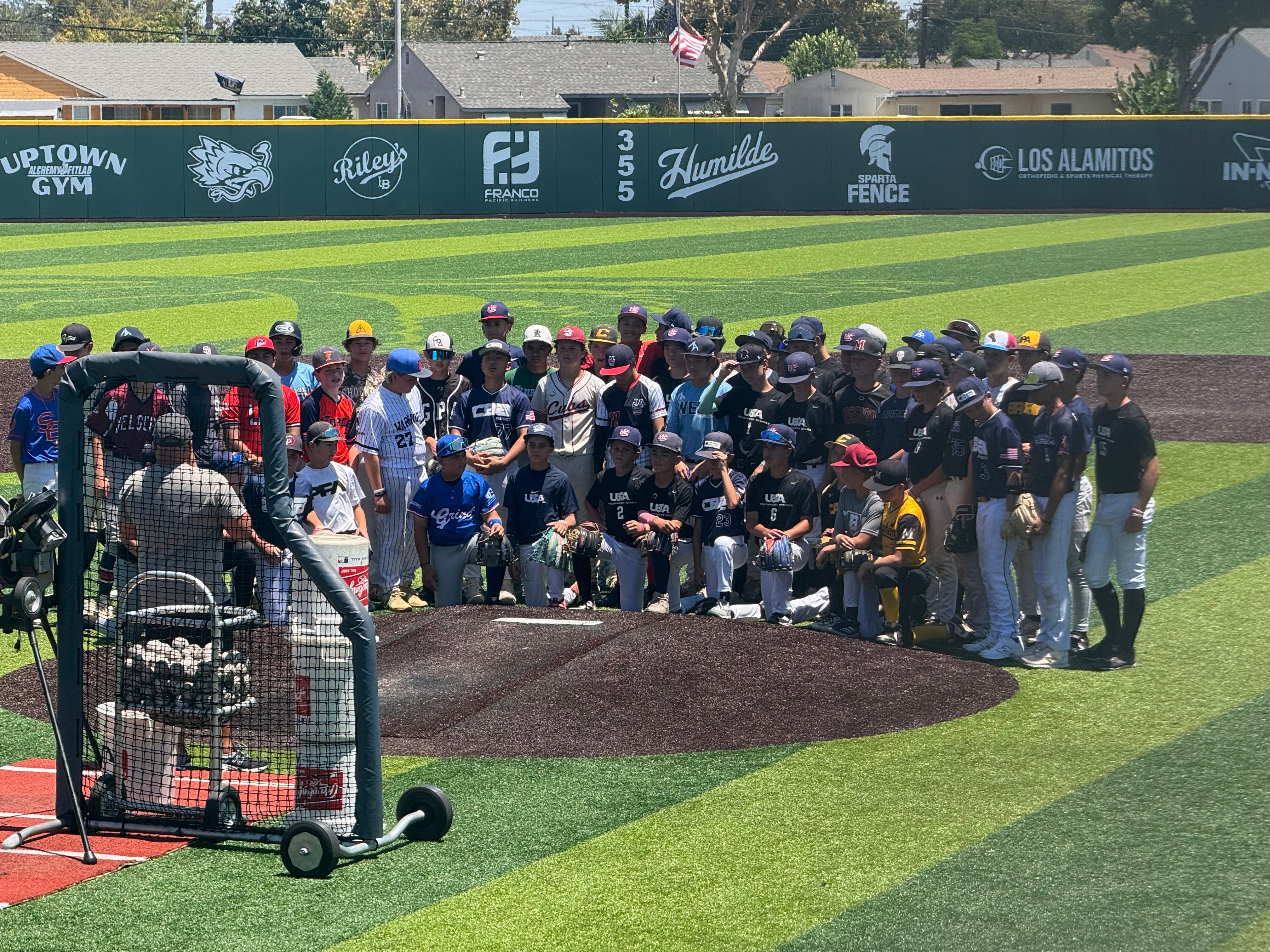
Last summer, a coach of Alex’s asked me, “Have you thought about reclassing?” I said, “Not really. I mean, I don’t know much about it but it’s probably a non-starter. Alex has a twin brother. We don’t want to split them up. We also don’t think baseball should trump academics, but I’ll look into it and talk it over with Alex and his Mom.”
Elizabeth was a hard no, though she agreed we should still discuss it with Alex. No rush, I thought back then. Plenty of time. Toward the end of 7th grade Alex brought it up. Before I could weigh in, Alex and his friends had already rendered their own verdict.
We could have held Alex and Nicky back a year when they were in daycare. They do have a late birthday compared to most of their friends at school, and they would have been born even later had they been born on time and not 7 weeks early. I remember when they were wrapping up daycare, a special place that served as the perfect head start for our boys and their sister before them. The question with the director came up, as it had with Natalie. Did we want to start the boys in kindergarten or wait another year?
“Oh, they’re ready for kindergarten,” Elizabeth said. “We love it here. But they’re so ready.”
They were happy, confident, outgoing, and smart back then. Big personalities with big smiles who seemed to rule the playground. They’re all those things and more today. It was the right decision.
The reclassification decision is one a lot of families of young athletes wrestle with, and I think it only makes sense for a small slice of them: kids born in June, July or August, the youngest in their grade which includes kids born between January 1 and August 31. Alex and Nicky were born at the end of May 2013. Had they been born on time, and not 7 weeks early, they’d have been July babies. Reclassification might have made more sense.
But I doubt Alex would want it anyway.
He is on the smaller side but he’s also more athletic than a lot of kids, and he has a strong arm. At a recent 13u tryout for USA Baseball, he was one of the youngest and the smallest, but he impressed enough to make the final round before he was cut. There were four or five kids smaller than him that day, out of a field of 50 or so, and he pointed that out to me in the truck afterward.
I said what I always do, “You’re gonna grow. You’re growing now—two inches over 5 weeks this summer. You have a cannon and you’re super athletic. No one is going to take those things from you. You’re going to keep getting stronger, and you’re still going to have all that athleticism.”
He listens, nods, and reflects. He hears me but he’s skeptical.
Here’s what I think a lot of parents get wrong about the trade. They believe their kid has real potential to make a D1 baseball roster, and who knows from there. Dreams are fine. I get it. But the numbers are brutal and they narrow at each stage: a sliver of high school players go D1, a sliver of those go pro, and a sliver of those ever see real money.
And what’s the lesson, really, in holding a kid back a year to dominate kids who are physically a year behind him? It’s the mustache joke made real. You’re not developing him. In some cases, you’re building the kid thirteen-year-olds make fun of at lunch.
There’s a lot that goes into recruiting, and yes, high school and travel coaches matter. But at the end of the day, what gets a kid recruited is him: the fire, the skills, the grades, the baseball IQ, whether he’s a good teammate who hustles. That’s the secret sauce. If he has it, someone will find him. And if he’s actually good enough for the pros, they’ll want him young. Youth is the asset up there, not something to manufacture with a redshirt year in middle school.
One more thing: hold him back and he gets hurt in a D1 program, and there's no cushion waiting for him anymore. In June, the NCAA's D1 cabinet voted to scrap the old redshirt and injury-waiver system for a straight age-based model — five years, no exceptions. The new rule takes effect in the fall of 2027 for anyone enrolling in college. Alex, and all the other 8th graders who don't reclass, will enter college in 2031.
Alex’s certainty doesn’t just show up at home. Most of his buddies at school are older and many of them played 13u travel ball this season while Alex stayed with his own 12u age group. They ribbed him sometimes about why he’s good enough to play for a top team at his age, instead of playing 13u like them. His answer: “Guys, I am 12.”
My advice: if you don’t want your kid to be the youngest in his grade and on the field, reclassification deserves consideration. Other than that, I don’t think it deserves much of your time compared to the other decisions we have to make as sports parents.
Regardless of how your kid stacks up, ask him what he wants. If he tells you he’d rather not be the guy with the mustache who looks like he drives himself to school, or the kid forced to make new friends while repeating courses he’s already mastered, follow his lead.
Go Deeper
As a parent coach, I help you help your kid play loose, with confidence and joy. The game gets harder, and our relationships suffer, when we add pressure.
If you’ve gotten the car ride home wrong, caught yourself coaching from the stands, or gotten caught up in the comparison trap, you’re not alone. None of us want to get these moments wrong. The good news: it’s fixable, and it starts with two short guides you can use before your kid’s next game.
Grab your parent playbooks — $20
Want something more specific worked through — your kid, your situation? I do that too.
Email me your issue and I’ll get back to you within 24 hours — $50
Book a coaching session — $150/45 minutes
Lastly, every week I drop new reels on Instagram: @tonymanolatos. Some are related to my essays. Some aren’t. It’s a place for parents to connect with me and each other, to share stories that are funny or moving, do’s and don’ts, and more.
About Baseball Dad & PR Guy
Baseball Dad & PR Guy is a weekly newsletter about youth sports culture and how parents and coaches shape the experience for young athletes.
Subscribers also get what I use after games—what to say, and what to leave unsaid on the ride home.
My essays are built around the 5 Moments That Shape Young Ballplayers, from the nerves before a game to the car ride home.
From the stands, I write about those moments and what they mean for confidence, identity, and a kid’s love of the game.
Read more about the 5 Moments and why they matter.
⚾ Join the conversation: Travel Baseball Moms & Dads (Facebook)
⚾ Follow along: Tony Manolatos – Baseball Dad & PR Guy (Facebook)More at tonymanolatos.com
Loved this piece. It's another one where your writing/story-telling really flowed, Tony. In the circles I run with, it's a topic I've heard discussed numerous times; however, I want to point out that your rendition might be the only one that really took the child's emotional perspective into account—outstanding work, my friend.