


A dad of a Division I college freshman ballplayer said some things to me last week that I wasn’t expecting to hear about his son’s baseball journey — and I’m really glad he did.
We were standing next to each other at a local hitting facility, watching our boys train in a small group — about seven players total — a mix of high school, college, and travel ball kids. His son was home for winter break, getting some extra work in. My 12-year-old, Alex, was right there with them, the youngest and smallest in the group, but engaged and soaking it all in.
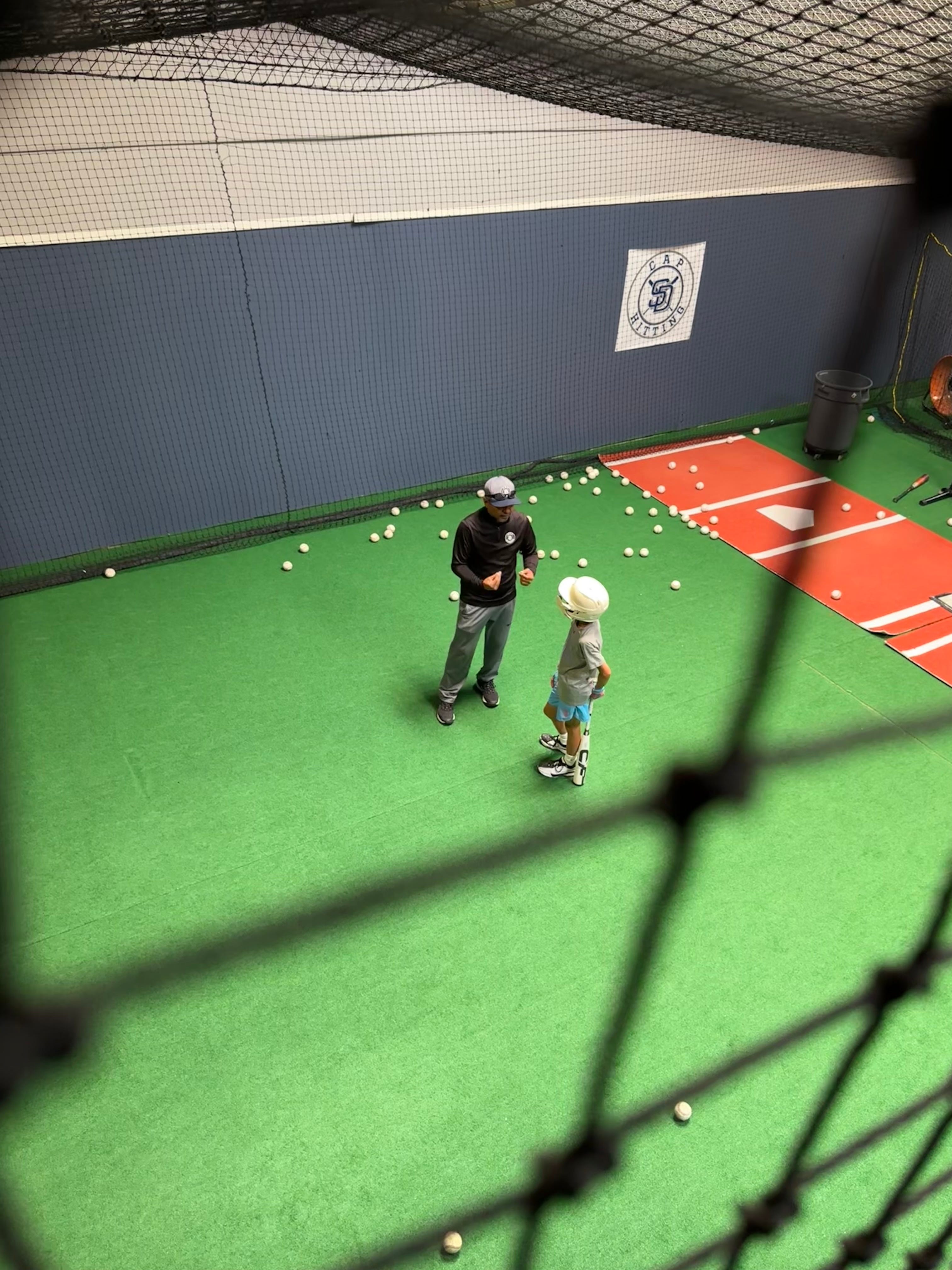
About 6 months ago Alex graduated from individual lessons to group. I love seeing him hit with older players. I love the confidence it builds, and the quiet connections that form. (Competitive group hitting sessions, where barrels are counted and losing teams do push-ups, are a topic for another story — but they’re incredibly valuable.)
What surprised me most that day, though, wasn’t what I saw — it was what I heard.
“All these kids can play. What separates them is mental toughness.”
This dad told me his son had three Division I offers coming out of high school. He chose his third option — the school that offered him last and dragged out the recruiting process.
“Why?” I asked.
“Because the coaches were the least full of shit,” he said. “We trusted them the most.”
Then he told me something every baseball parent should hear.
“If your kid doesn’t truly love the game — the grind — they won’t make it through their freshman year,” he said.
Why?
“Because they’re putting in six to seven hours a day.”
His son wakes up at 5:30 a.m. to lift with teammates for 90 minutes. After classes — which matter, because grades help determine roster spots — there’s practice for three hours. And then, often at night, they hit.
“A lot of that work isn’t required,” he said. “The coaches aren’t always allowed to be there. But it’s expected. And you don’t want to fall behind.”
Then he added this:
“There aren’t any pitchers throwing 80 down the middle anymore. Everyone throws 90–95 with real stuff. Sliders. Cutters. You’re expected to hit it.”
And then he said the thing that stuck with me most.
“All these kids can play,” he said, lifting his index fingers to his temples. “What separates them is this. The ones who survive are mentally tough.”
He told me his son took a break from travel ball at 13 and 14 to train and lift because he was undersized. Today, he looks like a college running back.
He’s a natural right-handed hitter who became a switch hitter after years of work — and now his left side is his stronger side because nearly 80 percent of pitchers are right-handed.
I soaked it all in. But the mental toughness piece stayed with me.
It reminded me of a podcast I’d just listened to: Elite Pitching Mindset with Florida State pitching coach Micah Posey.
Posey said when he recruits pitchers, he looks for mound presence.
Do they command the moment?
How do they respond when things go sideways?
Do they care about winning — or just their own stat line?
What does their face look like after a bad pitch?
Do they compete pitch to pitch — or let one mistake snowball?
Posey recommends The Mental ABC’s of Pitching by H.A. Dorfman and the Mental Warrior Program by Jaeger Sports — both excellent resources.
Two other podcasts I highly recommend:
The Way MLB Players Conquer Their Nerves and Doubts with Lauren Johnson (former Yankees mental conditioning coordinator)
Train Your Brain for the Big Leagues with Danielle Martin (founder of True Mindsets)
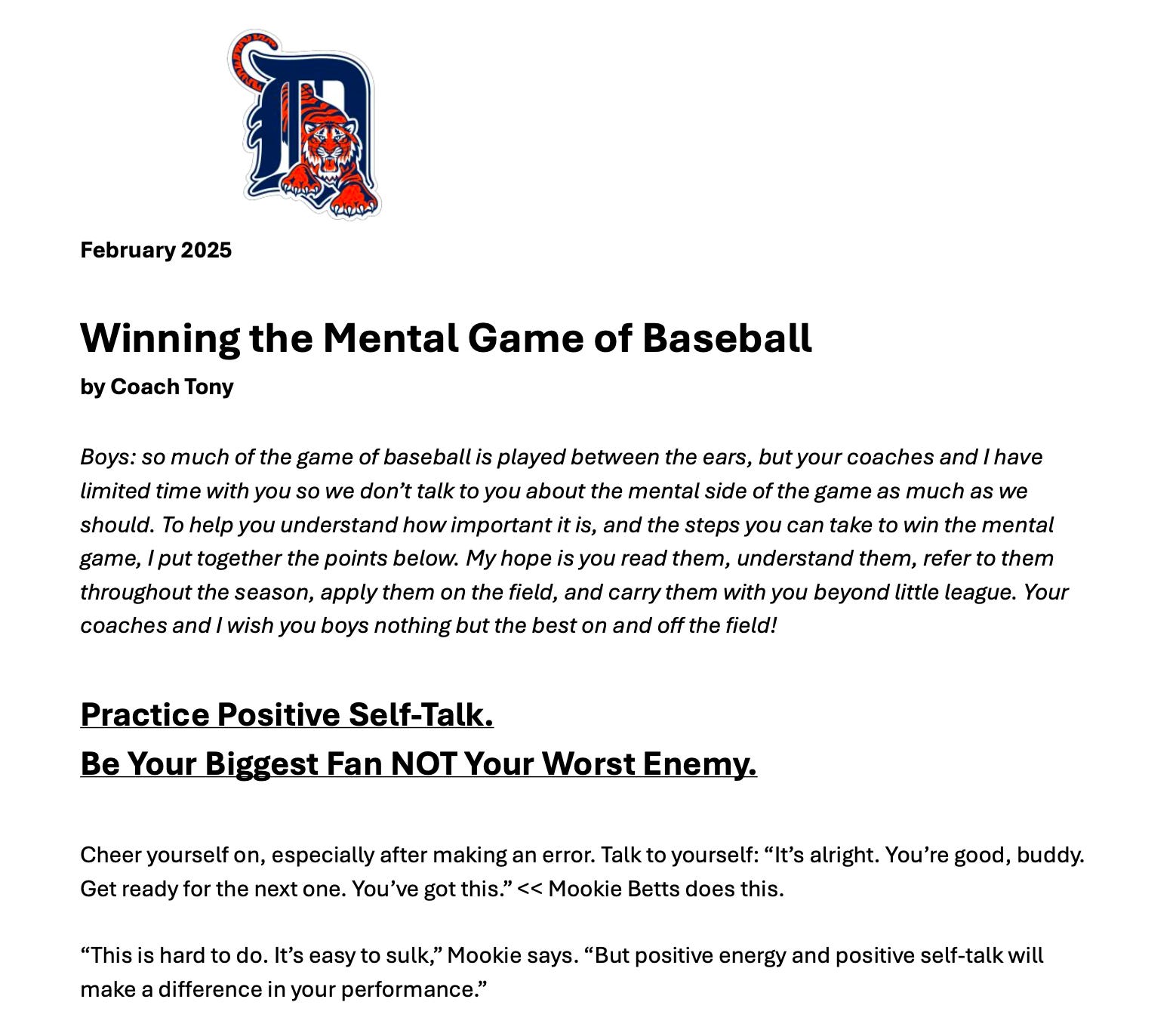
I’ll also share a booklet I created for a Little League team I managed last season: Winning the Mental Game of Baseball.
I ended that booklet with this message — and it applies here too:
Commit to the process. The results won’t always go your way — failure is part of baseball. When it happens, let it go. Prepare for the next opportunity. Trust your training. Tell yourself: “I’m ready. I’ve trained for this. I love this game.”
My dad used to say, “The game is played between the ears, son.”
He was right.
It’s easy for us parents to talk about mental toughness. It’s harder to create the space for it to grow.
That means letting our kids fail. Letting them struggle. Getting out of the way.
It’s painful. I get it.
But the kids who view setbacks as information and opportunities — who get back in the lab with curiosity instead of fear — they’re the ones who get back up after getting knocked down like nothing happened.
Life throws curveballs, a lot of them sometimes.
The kids who learn how to reset, adjust, and move forward are the ones best prepared to hit the next one — or take it for a strike and stay in the game.
If stories like this resonate with you, I share one every week here at Baseball Dad & PR Guy — honest lessons from youth baseball, parenting, and the moments in between. I’d love for you to join us. Hit that subscribe button. Thank you!
About Baseball Dad & PR Guy
I started Baseball Dad & PR Guy to share what I’ve learned from two worlds that have more in common than you’d think — youth baseball and public relations. Both teach preparation, communication, leadership, patience, and how to handle life’s curveballs.
Through my 12-year-old son Alex, his teammates, and his coaches, I’ve come to love baseball — all its beauty and all its challenges. My goal is to help baseball parents avoid common mistakes and support the journey their son or daughter is pursuing. On the PR side, my goal is to help young public relations professionals reach their potential.
Baseball and public relations both teach lessons that transcend the ball field and the PR world — so there’s really no reason not to subscribe.😎
⚾️ Join our growing community of parents helping parents: Travel Baseball Moms & Dads and Baseball Parents Podcast on Facebook. Please also check out my website, tonymanolatos.com, and my linkapalooza. 🔗