


If you’ve been around Little League or travel baseball long enough, you’ve heard someone say: There’s nothing tougher than watching your kid pitch.
There’s some truth to that — pitching puts your son or daughter on an island, in the spotlight, with every eye in the park waiting on their next pitch. But it doesn’t have to be miserable. And honestly, it should get easier.
Because pitching is simple in concept but incredibly hard in practice: execute your pitches. Strikeouts are a bonus. Some days they’ll feel electric, and some days they won’t have it. So the real question becomes:
How do you help your young pitcher manage their emotions — and yours — when the game starts pressing them?
A Fresh Example: Alex on the Mound Yesterday
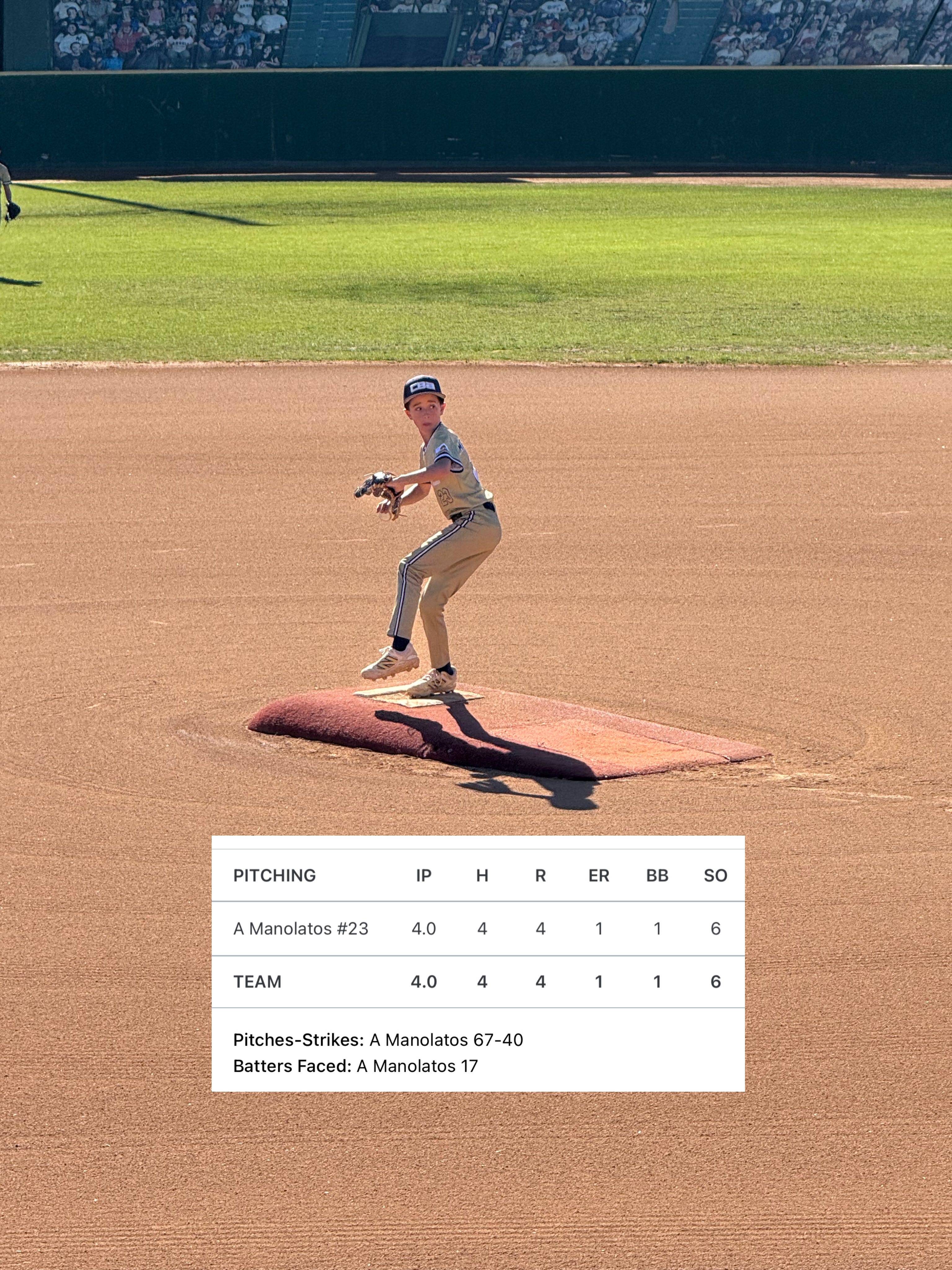
Our son Alex, who pitches for CBA San Diego, pitched yesterday (Saturday, Dec. 6) for his team. He started Game 2 of a doubleheader and he came out strong, but the top of the opposing lineup was fierce and barreled a lot of balls in that first inning.
Fast-forward to the fourth inning — the final inning. Alex is facing the top of the order again. The butterflies kick up for me, especially after a bloop single drops behind our second baseman.
I look at Alex.
Alex looks calm.
Attakid, I think.
He gets through the next three hitters with little trouble and helps secure his team’s second win of the day.
And moments like this? They’re earned — in bullpens, dry drills, long practices, and the quiet space between confidence and doubt.
The Quiet Work Behind the Scenes
On the long drive home yesterday from Perris to San Diego, Alex texted his pitching coach, Chad Starkey, a few photos I took of him on the mound:
“These are some of me leading with my front hip.”
His coach responded with praise and a one simple question:
“These are beyond great! How’d you feel today?”
Alex texted back:
“I felt confident and in control. All of my pitches were working and I was hitting my spots.”
That’s what growth sounds like and what mound maturity looks like — even at 12.
The Reality of Pitching (and Parenting)
Alex has pitched for years, so he’s learned to reset quickly when things go sideways. But he’s had rough outings and he will have more in the future. Even the best pitchers have bad games — nobody escapes that.
So when a bad inning happens, let it happen.
They’ll be fine, and so will you.
There’s nothing to be disappointed about. Your kid is playing a game they love. The sun is probably out. You’re at a ballfield instead of staring at a spreadsheet.
Kids will sometimes be frustrated by their performance. That’s normal.
But you don’t need to take on their frustration.
Your job is to stay steady, neutral, and supportive — especially when the game humbles them.
What NOT to Do From the Stands
Don’t bark instructions.
Don’t yell mechanics.
Don’t coach from the backstop.
They hear you — and so does their coach.
If Alex misses in the same spot twice, the most I might say is:
“Twice in the same spot — what’s the adjustment?”
And almost every time, the next pitch is a strike.
But 95% of what I say is simple and positive:
“Attaboy!”
“You got this, Alex!”
“Pound the zone, bud!”
“Nice pitch, kid!”
Short. Supportive. Steady.
Why I Love Watching Him Pitch
I never pitched growing up, so I’ve learned a ton from his coaches and from Alex himself. I can sometimes predict whether a pitch will be a strike before it reaches the plate by watching his delivery, but honestly, that’s not why I’m there.
I’m there to support my kid.
To enjoy watching him compete.
To witness the small, defining moments:
A deep breath.
A reset — seeing him step off the mound and think about his next pitch.
And then: a perfectly executed pitch right after giving up a rocket.
That’s growth. That’s resilience.
That’s why pitching is such a powerful teacher.
If You’re a Parent of a Pitcher — Here Are 10 Things to Help You and Your Kid
1. Become a student of pitching — together.
You don’t need expert knowledge, just enough to support them well.
2. Don’t press.
If they love pitching, they’ll want to do the work. If you push, it won’t last.
3. Find a great pitching coach.
Someone who teaches mechanics and mound presence.
4. Find a team that protects arms.
A good manager won’t over-pitch your kid under any circumstances.
5. Be their advocate.
Track pitches. Know the red flags. Protect their arm at all costs.
6. Praise effort — not outcomes.
Discipline outlasts velocity.
7. Normalize the struggle.
Failure is part of the job, it’s where growth happens.
8. Encourage them to talk to their coaches.
Help them build confidence in asking questions and seeking feedback.
9. Say less during games — and after.
Your emotional control becomes theirs.
10. Take them for a burger after the game.
Win or lose, refuel their tank with protein and love. If they want to talk, they will. If not, let it be.
The Heart of It All
Our job isn’t to control outcomes.
It’s to steady them through the storms, celebrate the courage it takes to stand alone on that mound, and help them become the kind of kid who keeps showing up.
Because pitching isn’t really about throwing baseballs.
It’s about becoming someone strong enough to handle the real world, as my dad would say.
And that’s a gift you get to help shape — one inning, one outing, one pitch at a time.
About Baseball Dad & PR Guy
I started Baseball Dad & PR Guy to share what I’ve learned from two worlds that have more in common than you’d think — youth baseball and public relations. Both teach preparation, communication, leadership, patience, and how to handle life’s curveballs.
Through my 12-year-old son Alex, his teammates, and his coaches, I’ve come to love baseball — all its beauty and all its challenges. My goal is to help baseball parents avoid common mistakes and support the journey their son or daughter is pursuing. On the PR side, my goal is to help young public relations professionals reach their potential.
Baseball and public relations both teach lessons that transcend the ball field and the PR world — so there’s really no reason not to subscribe.😎
⚾️ Join our growing community of parents helping parents: Travel Baseball Moms & Dads and Baseball Parents Podcast on Facebook. Please also check out my new website, tonymanolatos.com, and my linkapalooza. 🔗